
Toll-Free Routes in Hungary 2026: Which Roads Can You Drive Without a Vignette?

Mattijs Wijnmalen
CEO and co-founder
Key takeaway
- Most motorways and expressways in Hungary require an e-Matrica.
- County roads, local roads, and non-designated national roads are free to use.
- A short list of named motorway sections is currently toll-free. This list is subject to change, so verify before you travel.
- You get a 60-minute grace period after entering the tolled network to buy your vignette.
With a few specific exceptions, Hungary's motorway and expressway network is tolled, and driving on it without a valid Hungarian e-vignette means risking a fine. But not every road in the country works this way. A handful of motorway sections are genuinely toll-free, and the country's county roads, local roads, and ordinary national main roads carry no toll at all. This guide covers exactly which toll-free roads in Hungary exist in 2026, where the M0 and M1 really stand, and whether skipping the motorway is actually worth the extra time it costs.
The interactive map below shows the current toll-free sections in green against Hungary's tolled motorway network in red.
It's meant to give you a general sense of where the free stretches are. The exact boundaries of each tolled section are set by national decree and can change, so always confirm your specific route before you drive.
Top Toll-Free Routes & Exemptions: The Officially Free Motorway Sections
Under the current national decree, the following motorway and expressway sections are officially toll-free and require no e-Matrica of any kind. This list is accurate as of November 2026 and is reviewed periodically, so always confirm the current status before you travel:
- M4: the Vecsés – Budapest Liszt Ferenc International Airport section
- M4: the Törökszentmiklós – Kisújszállás section
- M60: the Pécs south-western bypass, between roads 58 and 5826
- M8, in full
- M80, in full
- M9: the section between main roads 6 and 51
- M9: the Kaposvár bypass (signposted as main road 61)
Any expressway or motorway section not on this list is tolled and requires a valid vignette for Hungary, including sections that were free in previous years. For the full picture of Hungary's tolled network, see our Hungary toll roads map.
Verify current status before travel: sections are set by national decree and can change.
| Road | Free Section | Notes |
|---|---|---|
| M4 | Vecsés – Budapest Liszt Ferenc Airport | Connects the airport to the wider motorway network |
| M4 | Törökszentmiklós – Kisújszállás | Toll-free along this stretch |
| M60 | Pécs south-western bypass (roads 58–5826) | Local bypass section |
| M8 | Full length | No charge anywhere on this road |
| M80 | Full length | No charge anywhere on this road |
| M9 | Main roads 6–51 section | Toll-free along this stretch |
| M9 | Kaposvár bypass (road 61) | Local bypass section |
Can I Drive in Hungary Without a Vignette?
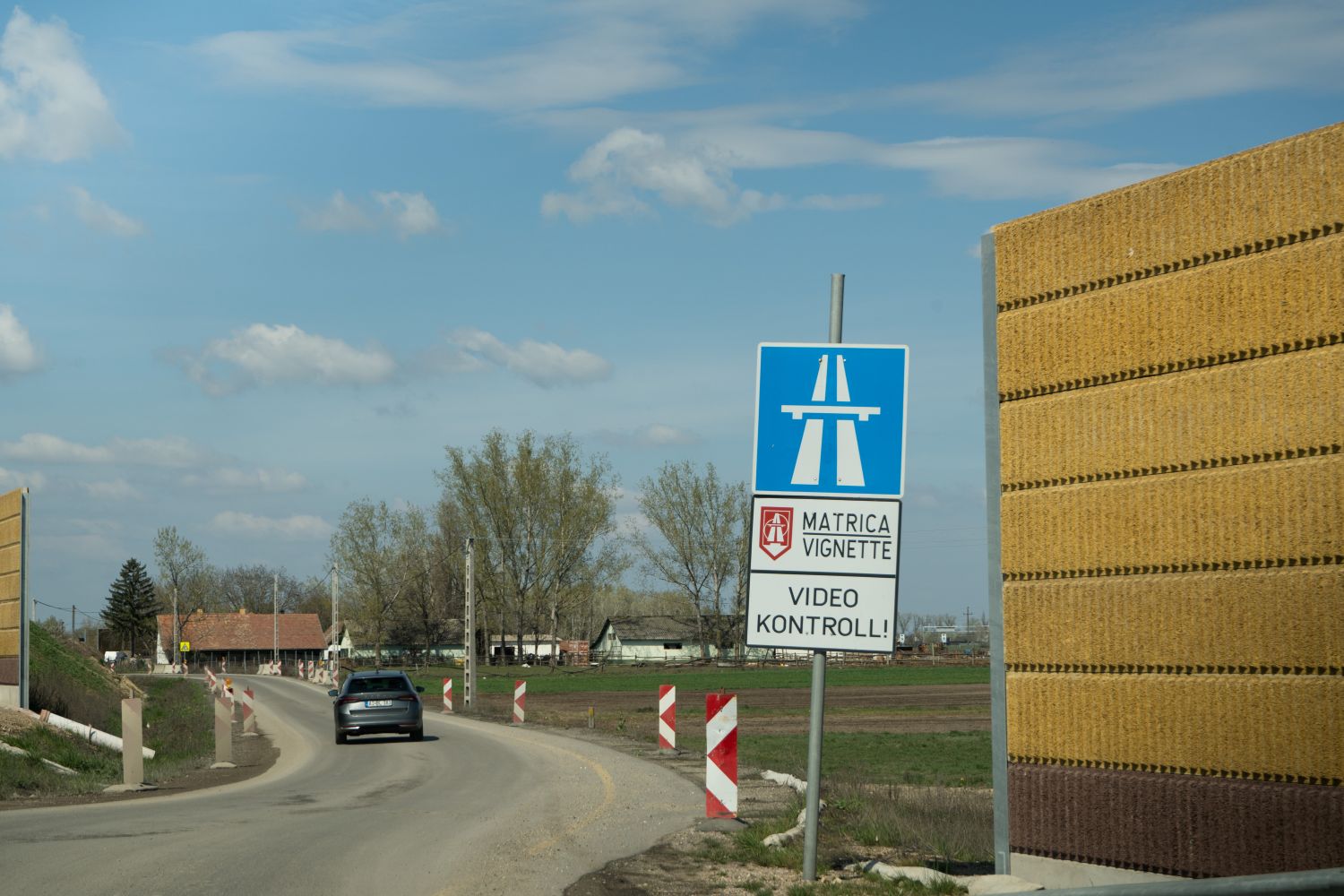
Yes. You can legally drive across Hungary without a vignette, as long as you stay off the tolled motorways (autópálya) and expressways (autóút). It's easy to set up: switch on 'avoid tolls' in your navigation app and you'll be routed along county roads and national main roads, which are free for every vehicle. Be careful for a wrong turn, if you end up on a tolled part of the motorway you get instantly fined. The toll-free motorway sections listed above are also open to you without an e-Matrica, but expect a slower journey overall.
What Are the Toll-Free Alternatives to Hungary's Main Motorways?
Beyond the named exceptions above, Hungary's non-motorway road network carries no toll at all. County roads, local and municipal roads, and ordinary national main roads (the single- and double-digit 'főút' roads such as Route 1, Route 6, and Route 7) are free for every vehicle. Only roads classified as autópálya (motorway) or autóút (expressway) and included on the charged-road list require an e-Matrica.
Driving in Hungary on these free alternatives comes with real trade-offs. Main roads pass through towns and villages. Speed limits are lower, and you'll often get stuck behind local traffic, junctions, or agricultural vehicles. Road surfaces can be inconsistent on rural stretches too, which limits your overtaking options. On the upside, these roads are often more scenic. They follow a more traditional route through the countryside. And they give you a better sense of small-town Hungary than any motorway can.
For a short local trip, that trade-off might make sense, especially if you're not in a hurry and want to see more of the country along the way. For a longer cross-country journey, though, the extra time adds up. It usually outweighs whatever you'd save by skipping the vignette. Delays from town centres, junctions, and lower speed limits stack up fast over a few hundred kilometres.
Can You Reach Budapest from the Austrian Border Toll-Free?
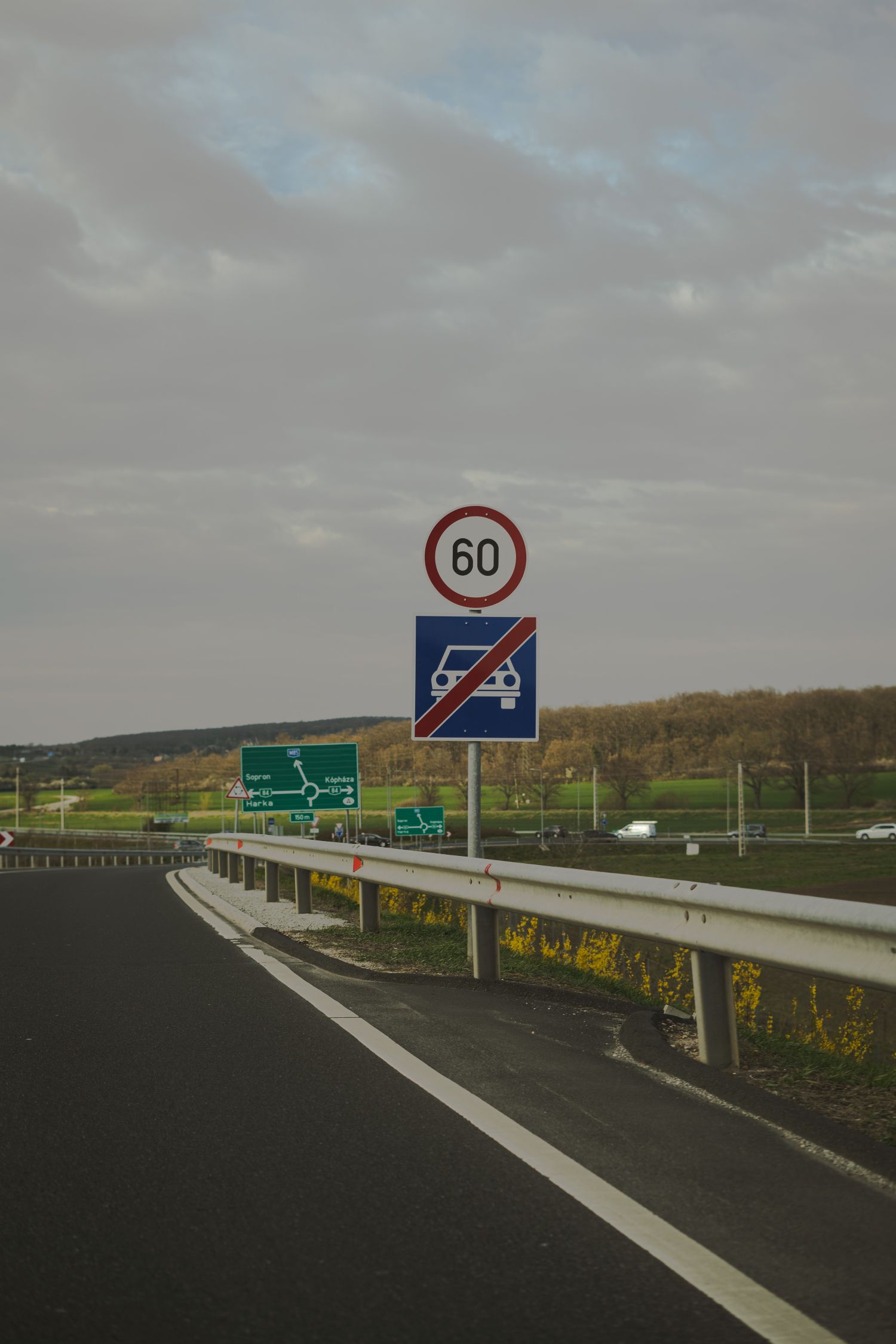
If you're driving in from Austria or Germany, the direct route into Budapest runs along the M1 from the Hegyeshalom border crossing, and the M1 is fully tolled along its entire length.
Our team drove this exact stretch during a research trip in early 2026: camera enforcement gantries were already scanning vehicles within the first 200 metres past the Hegyeshalom border, with no kiosk and no way to buy a vignette on the spot. If you cross without one already active, you're exposed from the very first moment.
The toll-free alternative is Main Road 1 (Route 1), running roughly parallel through Győr, Tata, and Tatabánya. It's a real toll-free route, but a slower one, passing through towns with lower speed limits and traffic lights, adding at least an hour to the journey, sometimes considerably more depending on traffic.
For most drivers, the extra time isn't worth what a short-term e-Matrica costs. A 10-day vignette is a modest expense next to the added driving time on Route 1, especially if you're only passing through Hungary.
Is the M0 Budapest Ring Road Toll-Free?
No. Since January 2024, the entire M0 was tolled. The Megyeri Bridge was one of the last free stretches. It became part of the charged network on 1 January 2024, alongside the M0's south and east sectors.
This is one of the most common mistakes drivers make. It's also one of the costliest. Older maps and outdated advice are often to blame. They still describe parts of the ring road as free.
If your route touches the M0, assume you need a valid e-Matrica. This applies whether you're passing through or looping around Budapest. Coverage can vary by vignette type. Check your junction-to-junction section against the official toll-road source before you travel. Don't rely on what worked in previous years.
The "60-Minute Rule" and GPS Navigation Tips
A few practical points can save you both time and money once you're on the road.
- The 60-minute rule: if you enter the tolled network, you have 60 minutes from the moment of entry to buy your road-use authorisation before it's treated as a violation. This exists to protect drivers who join the network by mistake or in a hurry. It isn't a loophole for skipping the toll altogether.
- GPS navigation: most mapping apps, along with Hungary's official route planner and county maps, offer an 'avoid toll roads' or 'avoid motorways' option. These are useful starting points, but consumer GPS apps aren't always current on which exact sections are tolled, so cross-check your planned route against the official toll-road map before you set off.
- Enforcement: Hungary's toll network has no physical booths. It's entirely camera-based, using fixed cameras and mobile checking units tied to your licence plate, so even an accidental entry onto a tolled section is recorded and detectable.
Fair warning: the 60-minute window only protects you if the e-Matrica you buy matches your licence plate and vehicle category and is valid for the day you're driving. A purchase made after 60 minutes, or with the wrong details, will not prevent a fine.
Recent Changes for 2026
A few things are worth knowing if you're planning a 2026 trip. The list of toll-free sections is reviewed periodically under the governing national decree, so it can shift from year to year, and the roads listed above reflect the current position rather than a permanent guarantee.
The e-Matrica system is currently operated by Nemzeti Mobilfizetési Zrt. For heavy vehicles over 3.5 tonnes, the separate HU-GO route-ticket validity window also changed in 2026, extending from 120 to 300 minutes as of 1 May, per Government Decree 77/2026 (III. 27.).
None of these changes affect which roads are toll-free day to day, but they're a reminder that Hungary's toll rules are genuinely subject to change. Always confirm the current position before you rely on it.
Free routes that avoid the toll are limited and slower, so buying your e-Matrica before you drive is the practical choice for most trips, with 10-day passes starting from around HUF 6,900 (roughly €17). Already bought one? Use our validity check to confirm it's active and registered to the right licence plate before you set off.
FAQ
Written by: Freek Jurg, COO and Co-founder, Maut & Vignette B.V., 10+ years in tolling.
Reviewed by: Mattijs Wijnmalen, CEO and Co-founder, Maut & Vignette B.V., 10 years in European road tolling. Mattijs drove the M1, M5 and M7 corridors, including the Hegyeshalom border crossing, in April 2026 to research this guide.
Photography: Mattijs Wijnmalen, March 2026.
Last verified: June 2026.
Sources: NÚSz, the National Toll Payment Service (ematrica.nemzetiutdij.hu), Nemzeti Mobilfizetési Zrt. (National Mobile Payment Plc.), the operator of the national e-Matrica system, and Decree 45/2020 (XI. 28.) ITM, which governs Hungary's toll road network and charges.
This guide is for informational purposes only. E-Matrica prices, validity rules, and enforcement details can change. Always verify current information at ematrica.nemzetiutdij.hu before travelling. evignettehungary.com is a private reseller of Hungarian e-Matricas and is not affiliated with NÚSz, Nemzeti Mobilfizetési Zrt., or any official Hungarian toll authority.

Freek Jurg is the COO and co-founder of Evignettehungary.com's operator, Maut & Vignette B.V. He co-founded the business with Mattijs Wijnmalen in 2014 and looks after day-to-day operations, including order processing and the IT integrations that register each vignette against the right vehicle.