
Hungary Toll Roads Map 2026 - Which Roads Require an E-Matrica?

Mattijs Wijnmalen
CEO and co-founder
Quick Answer
Hungary's toll motorways and expressways, all carrying an M number, total about 1,750 km and require a valid e-Matrica for cars, motorcycles, and vans. Trucks and buses over 3.5 tonnes use the separate HU-GO system. Drive onto a toll section without one and you have 60 minutes to fix it online before a fine follows.
If you're planning a route through Hungary, you need a clear picture of the Hungarian toll road network before you cross the border. The country runs its motorways on an electronic vignette for Hungary, the e-Matrica, covering every M-prefix road, roughly 1,750 km in total. This guide maps the network by corridor, from the M1 near Vienna to the M7 toward Croatia, so you can confirm your route and buy before you drive.
Principal Toll Motorways: The M-Road Network at a Glance
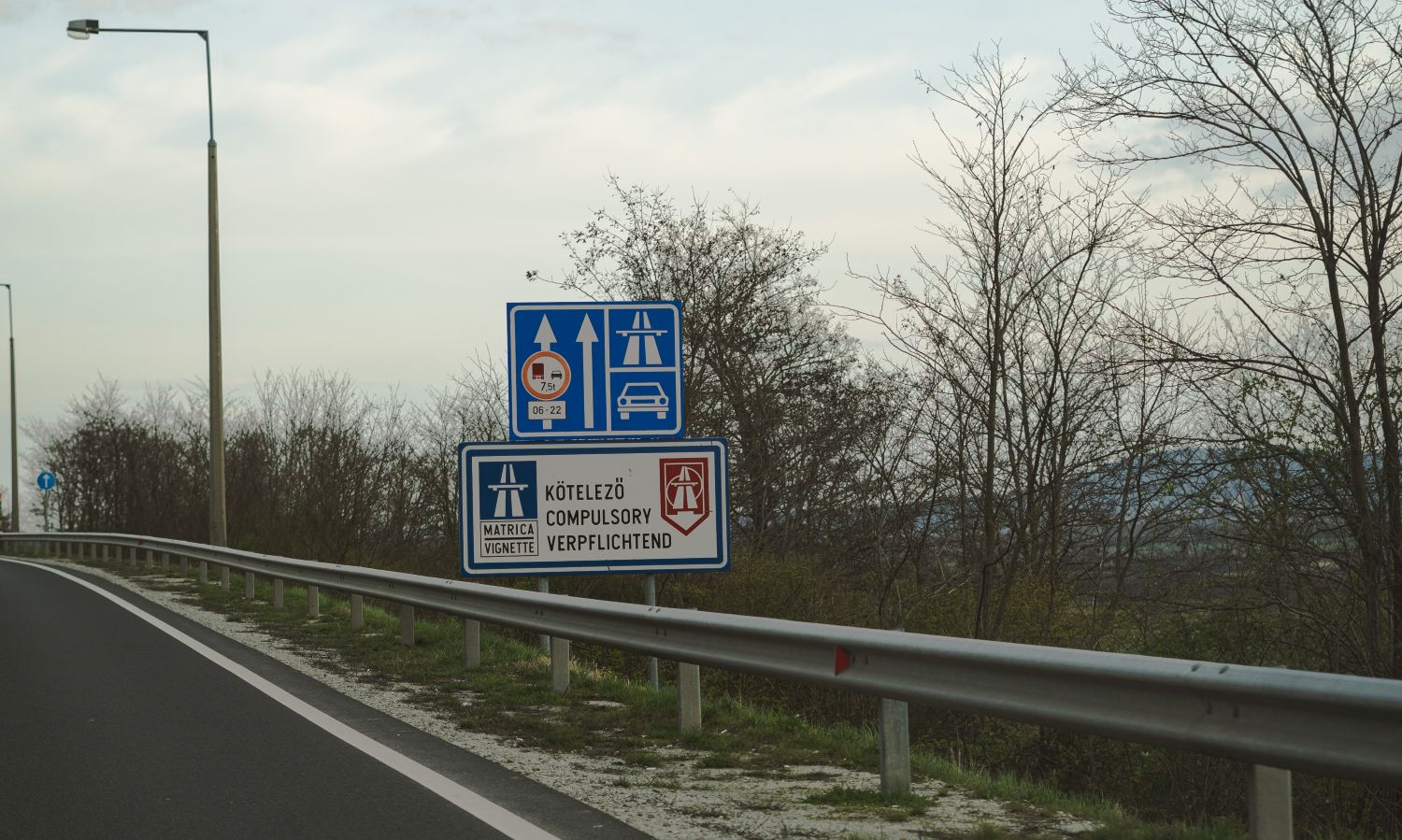
Any road carrying an M number falls under the e-vignette system. Motorways, called autópálya in Hungarian, allow speeds up to 130 km/h and always include an emergency lane. Expressways, known as autóút, cap out at 110 km/h and sometimes narrow without a hard shoulder. Either way, both need a valid vignette for Hungary for any vehicle up to 3.5 tonnes.
Use our interactive map to see if you drive on a Hungarian Toll road.
This network is run by Magyar Közút Nonprofit Zrt. – Útdíj Üzletág, successor to the National Toll Payment Service (NÚSz) since 1 January 2026. The table below breaks down the main M-roads by corridor.
| Road | Corridor / Direction | Key Cities | Border Served | e-Matrica Required |
|---|---|---|---|---|
| M1 | West, Budapest to Austria | Budapest, Győr | Hegyeshalom (Austria) | Yes, full length |
| M15 | West, branch from M1 | Mosonmagyaróvár | Rajka (Slovakia) | Yes |
| M3 | East, Budapest to Ukraine | Gödöllő, Nyíregyháza | Transit corridor | Yes |
| M30 | East, branch from M3 | Miskolc | Tornyosnémeti (Slovakia) | Yes |
| M4 | East, Budapest to Romania | Nagykereki | Romania (Oradea) | Yes |
| M5 | South, Budapest to Serbia | Kecskemét, Szeged | Röszke (Serbia) | Yes |
| M43 | South, branch from M5 | Szeged | Romania (Arad) | Yes |
| M7 | Southwest, Budapest to Croatia | Lake Balaton, Letenye | Croatia (Zagreb) | Yes |
| M70 | Southwest, branch from M7 | Letenye | Slovenia (Maribor) | Yes |
| M0 | Budapest ring road | Budapest | Not applicable | Partial, see below |
How Much Does a Hungarian Vignette (E-Matrica) Cost?
For quick reference, here are the official 2026 national e-Matrica rates by category (D1 covers most passenger cars, D2 covers larger vehicles and vans up to 3.5 tonnes). These are the base government rates before any service fee; see current 2026 prices for the exact checkout price.
| Category | 1-Day | 10-Day | Monthly | Annual (National) |
|---|---|---|---|---|
| D1 (cars, up to 7 seats) | 5,550 Ft | 6,900 Ft | 11,170 Ft | 61,760 Ft |
| D1M (motorcycles) | 2,770 Ft | 3,450 Ft | 5,590 Ft | 61,760 Ft |
| D2 (vans/motorhomes/minibuses, up to 3.5t) | 7,890 Ft | 10,040 Ft | 15,820 Ft | 87,650 Ft |
Key Vignette Corridors by Direction
Hungary's motorways run outwards from Budapest towards the borders, so the network is easiest to plan by direction of travel. Each section below groups a main M-road with its branches and the border crossing it serves, followed by the M0 ring road around the capital. A national e-Matrica covers all of them, while a county vignette only covers the stretch inside that county.
Westbound to Austria and Slovakia: The M1 (and M15)
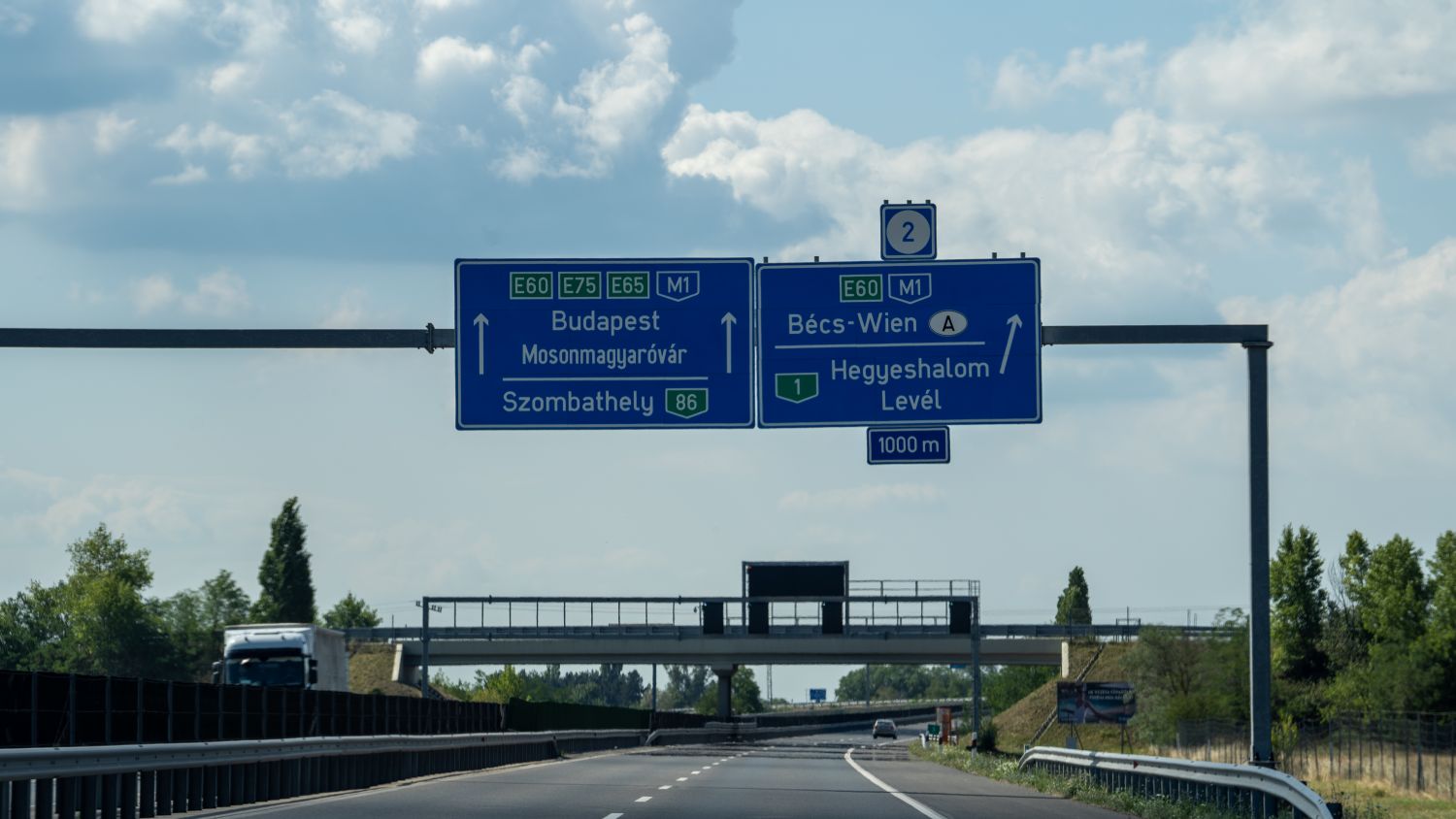
The M1 is Hungary's oldest motorway and the main route from Germany and Austria, running from Budapest through Tatabánya and Győr to Hegyeshalom and the Austrian A4 toward Vienna. It's also one of the busiest: Magyar Közút's 2022 count showed around 82,000 vehicles a day near Biatorbágy, just outside Budapest. Our team's April 2026 field visit to Hegyeshalom confirmed clear e-Matrica signage on approach. The M15 branches near Mosonmagyaróvár toward Rajka and Slovakia's D2, both falling under the D1/D2 vehicle categories used network-wide. Nearby, the M86 links Szombathely to Csorna, feeding the M85 corridor without itself reaching Austria. During a field visit to the Rajka crossing on the M15, our team found no border checkpoints at all, just open Schengen-area driving, with clear "Toll Control" signage and camera gantries on the approach roads.
Eastbound to Ukraine and Romania: The M3 (and M30, M35, M4)
The M3 runs from Budapest through Gödöllő to Nyíregyháza, toward Ukraine. The M30 branches toward Miskolc and Tornyosnémeti at the Slovak border, part of the Via Carpathia corridor. The M35 connects to Debrecen, and the M4 runs to Nagykereki and into Romania toward Oradea, with the same e-Matrica coverage as the M3. Our team's field visit to the M4 toward the Nagykereki–Borș crossing found noticeably lighter traffic than the M5/M43 corridor, with clear roadside "Rovinieta" signage marking where to buy Romania's vignette right at the border.
Southbound to Serbia and Romania: The M5 (and M43)
The M5 connects Budapest to Kecskemét and Szeged before reaching Röszke at the Serbian border, linking to Serbia's A1 toward Belgrade as part of Pan-European Corridor X. The M43 branches near Szeged toward Arad and Timișoara in Romania. Both are fully tolled. At the M43's Nădlac II crossing, our team encountered fast-moving traffic with minimal police presence; the older, non-motorway Nagylak crossing nearby offered an even quicker, control-free alternative during our visit.
Southwest to Croatia and Slovenia: The M7 (and M70, M6)
The M7 is Hungary's busiest holiday route, running past Lake Balaton to Letenye and Croatia's A4 toward Zagreb, with heavy summer traffic. The M70 branches at Letenye toward Slovenia's Maribor. Since October 2025, the M6 offers a second Croatia crossing, at Ivándárda.
A cautionary case worth knowing: a Canadian driver on Reddit's r/hungary described a roughly HUF 60,000 fine for driving the M7 near Lake Balaton in a rental car, arriving about ten months later. We regularly see clients make costly mistakes here, most often picking the wrong vehicle category or assuming a local county vignette covers a route it doesn't. Because enforcement runs entirely on cameras, a fine can be issued for each day you're caught driving without a valid e-Matrica, not just once, so a short stretch of uncovered driving can turn into a surprisingly large bill fast. Confirming your e-Matrica beforehand matters far more than watching for a sticker that does not exist.
The Budapest Ring: The M0
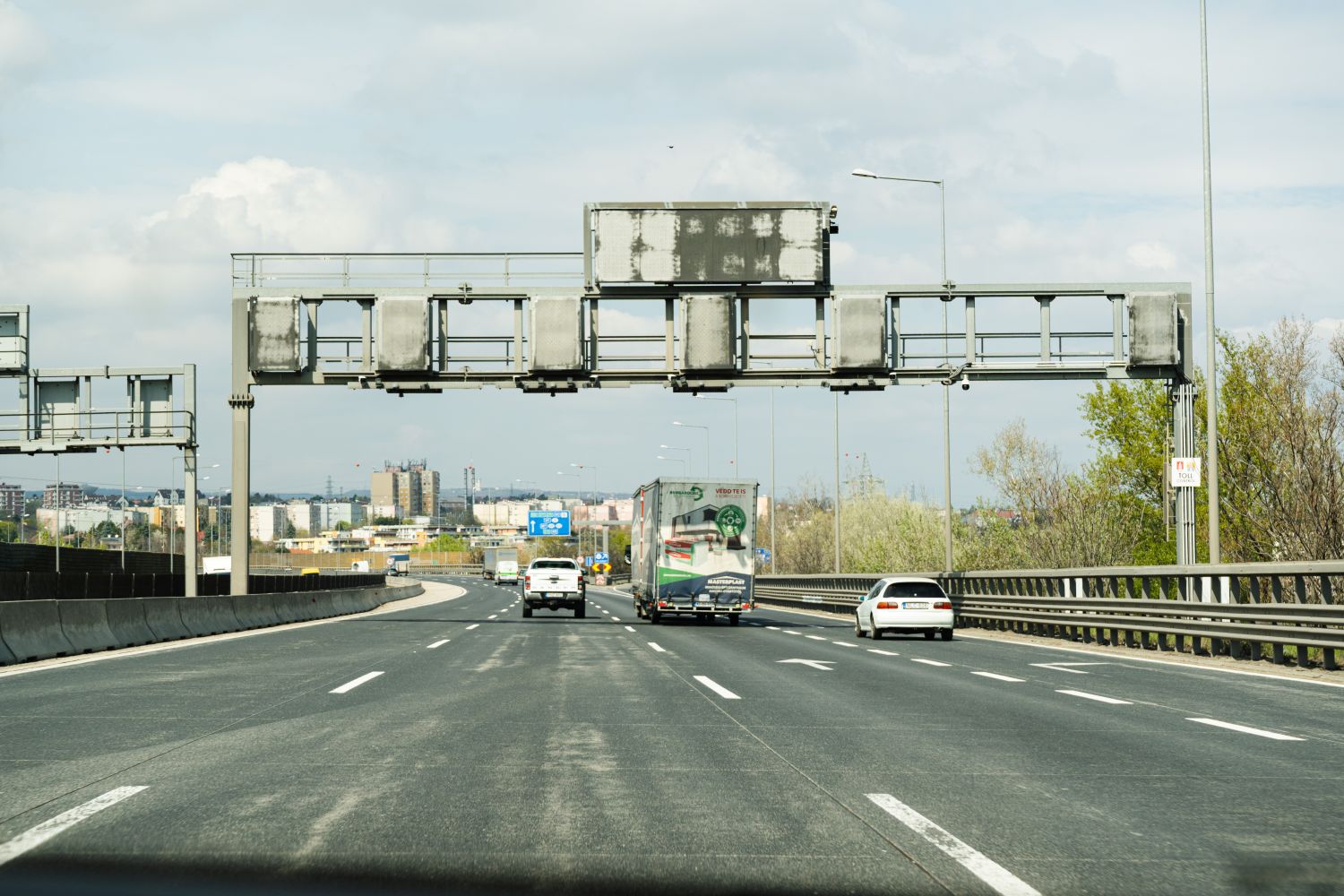
The M0 loops around Budapest, tying together the M1, M7, M6, M5, M4, M3, and M2, with the smaller M31 and M51 feeding in too. It is genuinely mixed: toll-free stretches include the section between Main Road 1 and the M5, the M4-to-M3 link, and the Megyeri Bridge section between Main Roads 2 and 11. Every other section requires a valid e-Matrica, so check your specific stretch rather than assuming the whole ring is one or the other. Driving the M0 during a field visit, our team found the overhead gantries stay active for vignette and speed checks even when their displays appear blank, and that missing the correct lane on approach can easily cost 10–15 minutes in traffic.
How Does Toll Enforcement Work? Cameras and the 60-Minute Grace Period
Hungary polices its toll roads entirely through technology, with no barriers or staffed booths. Roadside camera towers, patrol vehicles, and temporary control points do the work, all run by Magyar Közút Nonprofit Zrt. – Útdíj Üzletág, the legal successor to NÚSz as of 1 January 2026. Your plate is matched against the e-Matrica database the moment you pass a scan point.
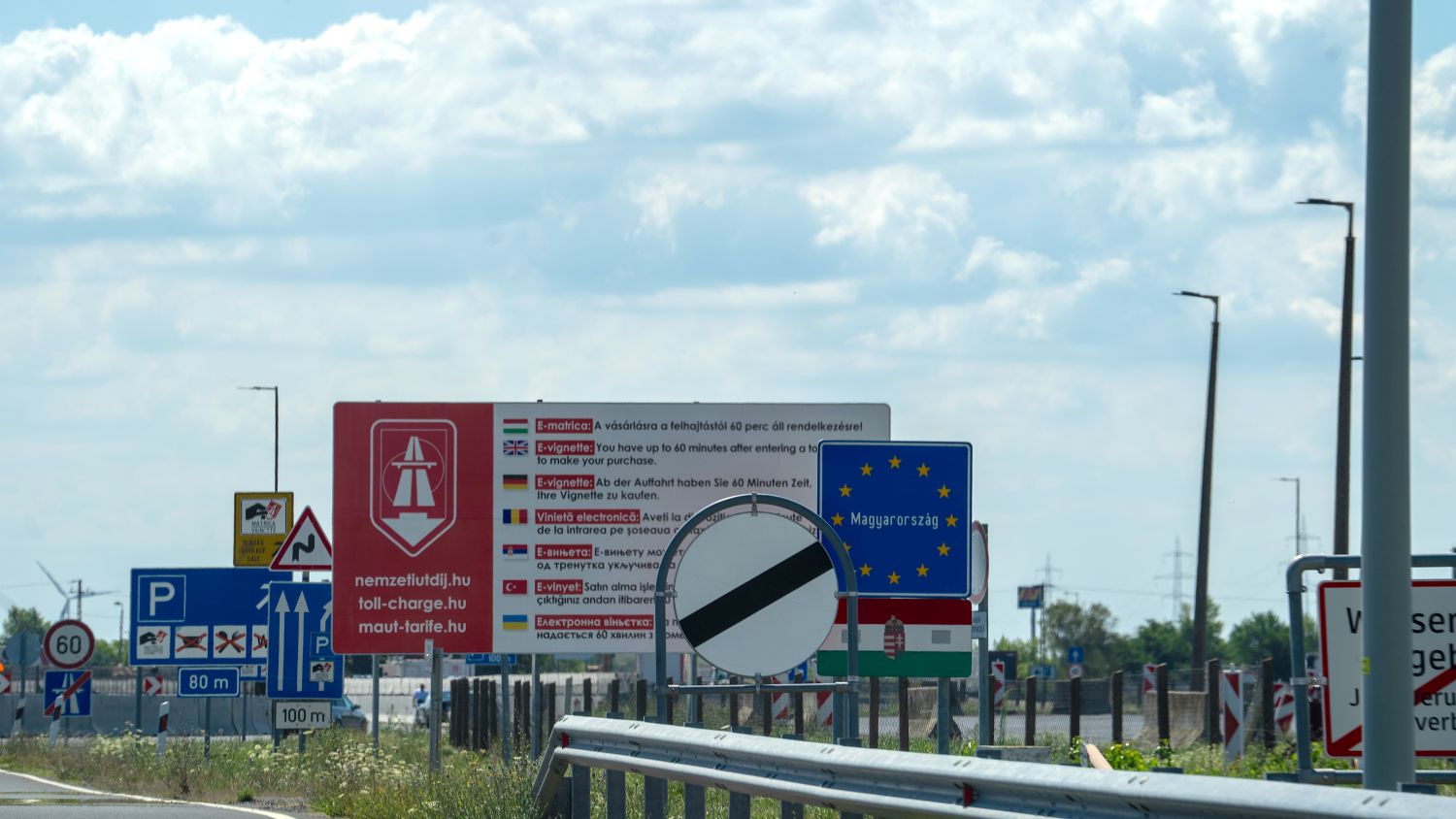
If you accidentally enter a toll road without a valid vignette, you get a 60-minute grace period from entry to buy one. This protects honest mistakes, not as a general safety net, so the safest approach is still to buy before you set off.
After the grace period expires, the basic surcharge is HUF 27,790 if paid within 60 days, rising to HUF 95,730 if unpaid beyond that. The same surcharge applies if your vignette category doesn't match your vehicle, for example a seven-plus-seat car registered under D1 instead of D2. That's the official rule, but in practice we still see drivers get fined despite believing they were covered, so it pays to double-check your category and coverage rather than assume. See our full breakdown of Hungary Motorway fines for other edge cases.
Regional and County E-Matrica Highways Mapping
If your trip stays within specific regions of Hungary, a regional (county) annual e-Matrica can be much cheaper than the nationwide option. Hungary is divided into 19 counties, and regional vignettes are available for each:
- Bács-Kiskun
- Baranya
- Békés
- Borsod-Abaúj-Zemplén
- Csongrád-Csanád
- Fejér
- Győr-Moson-Sopron
- Hajdú-Bihar
- Heves
- Jász-Nagykun-Szolnok
- Komárom-Esztergom
- Pest
- Somogy
- Szabolcs-Szatmár-Bereg
- Tolna
- Vas
- Veszprém
- Zala
Note: Budapest does not have its own separate vignette — all toll roads around the capital are covered by the Pest County vignette. A county vignette is valid up to the first exit junction past the county border in the neighboring county.
New for 2026 is a separate M1 regional vignette, a discounted annual pass for regular M1 users during its reconstruction. It covers four counties rather than a single one: Pest, Fejér, Komárom-Esztergom and Győr-Moson-Sopron.
Official county maps mark toll sections in red and toll-free sections in green.
| County | Toll Roads Covered | Annual Price (D1/D1M/U) | Annual Price (D2) |
|---|---|---|---|
| Bács-Kiskun | M5, M44 | 7,190 Ft | 14,370 Ft |
| Baranya | M6, M60 | 7,190 Ft | 14,370 Ft |
| Békés | M44 | 7,190 Ft | 14,370 Ft |
| Borsod-Abaúj-Zemplén | M3, M30 | 2,500 Ft (2026 discounted) | 5,000 Ft (2026 discounted) |
| Csongrád-Csanád | M5, M43 | 7,190 Ft | 14,370 Ft |
| Fejér | M1, M6, M7 | 7,190 Ft | 14,370 Ft |
| Győr-Moson-Sopron | M1, M85, M86 | 7,190 Ft | 14,370 Ft |
| Hajdú-Bihar | M3, M35, M4 | 7,190 Ft | 14,370 Ft |
| Heves | M3, M25 | 7,190 Ft | 14,370 Ft |
| Jász-Nagykun-Szolnok | M4, M44 | 7,190 Ft | 14,370 Ft |
| Komárom-Esztergom | M1 | 7,190 Ft | 14,370 Ft |
| Pest | M0, M1, M2, M3, M4, M5, M6, M7, M31 | 7,190 Ft | 14,370 Ft |
| Somogy | M7 | 7,190 Ft | 14,370 Ft |
| Szabolcs-Szatmár-Bereg | M3 | 7,190 Ft | 14,370 Ft |
| Tolna | M6 | 7,190 Ft | 14,370 Ft |
| Vas | M86 | 7,190 Ft | 14,370 Ft |
| Veszprém | M7 (short stretch only) | 7,190 Ft | 14,370 Ft |
| Zala | M7, M70 | 7,190 Ft | 14,370 Ft |
What Are the Toll-Free Roads and When Does HU-GO Apply?
Plenty of driving in Hungary happens outside the toll system altogether. Ordinary main roads, minor local routes, and anything not designated part of the motorway network can be driven free of charge, though expect a slower, less direct trip.
A handful of M-road sections are themselves toll-free too, including the M60 Pécs southwest bypass, the M4 section between Vecsés and Budapest Ferenc Liszt Airport, the M9 between Main Roads 6 and 51 with its Kaposvár bypass, and small sections of the M0, M76, M8, and M31.
A small set of vehicles are exempt from the e-Matrica entirely:
- Emergency services (ambulance, fire brigade, police);
- Hungarian Defence Forces vehicles;
- Certain vehicles covered by international treaties;
- Some vehicles carrying an official disabled permit.
Electric and hybrid vehicles get no exemption or discount in Hungary. EVs, hybrids, and plug-in hybrids all need a valid e-Matrica, the same as any petrol or diesel car.
Once your vehicle passes 3.5 tonnes, HU-GO applies instead, billing by the kilometre driven rather than a flat fee. Since 1 May 2026, HU-GO route tickets stay valid for 300 minutes after purchase, up from 120. Motorhomes and campervans still need an ordinary e-Matrica regardless of weight. See our vehicle requirements guide if unsure which system applies to you.
HU-GO sorts heavier vehicles into categories J2 through J5 based on axle count, with higher categories paying more per kilometre; cleaner EURO emission classes get a lower rate within each category. Settlement runs either through a route ticket for a single trip or an on-board unit (OBU) linked to a prepaid HU-GO account, which is the more practical option for anyone crossing Hungary regularly.
Once you have matched your route to a corridor above, buy your e-Matrica before you reach the border, not after. We're an independent registration partner, not a Hungarian government body, and we handle the actual registration with Magyar Közút's system on your behalf. Already bought one? You can check your e-Matrica's validity at any time.
FAQ
Written by: Freek Jurg, COO and Co-founder, Maut & Vignette B.V., 10+ years in tolling.
Reviewed by: Mattijs Wijnmalen, CEO and Co-founder, Maut & Vignette B.V., 10 years in European road tolling. Mattijs drove the M1, M5 and M7 corridors, including the Hegyeshalom border crossing, in April 2026 to research this guide.
Photography: Mattijs Wijnmalen, March 2026.
Last verified: October 2026.
Sources: Sources: Magyar Közút Nonprofit Zrt. Toll Division, the official Hungarian toll operator, and hu-go.hu, the official HU-GO distance-based toll website.

Freek Jurg is the COO and co-founder of Evignettehungary.com's operator, Maut & Vignette B.V. He co-founded the business with Mattijs Wijnmalen in 2014 and looks after day-to-day operations, including order processing and the IT integrations that register each vignette against the right vehicle.