
Hungary Toll Exemptions 2026: Who Doesn't Need an E-Matrica?

Mattijs Wijnmalen
CEO and co-founder
Quick Answer
Hungary vignette exemptions are rarer than most drivers assume. An electric car won't get you out of buying an e-Matrica, and neither will a disability permit on its own. The list of vehicles that genuinely skip it is short: ambulances, police, the military, road maintenance crews, diplomatic and aid transport, and officially classified vintage vehicles. Everyone else pays. That includes motorcyclists, and it includes electric, hybrid, and CNG drivers, who pay the same as any petrol car. Some disability permit holders do get a cheaper rate, but that's a discount, not a free pass.
Not sure if you actually need to buy a Hungary vignette for your 2026 trip? Motorcycles aren't exempt nor are electric cars. Those two assumptions cost drivers money every year. Below, you'll find the real exempt categories, a straight answer on those two myths, and the steps for registering a genuine exemption before driving in Hungary, so you know exactly where you stand before you drive.
Who Is Really Exempt From the Hungary Vignette?
Only a limited number of vehicles are exempt from the Hungary vignette: emergency services, police and military vehicles, road and toll authorities, diplomatic and humanitarian transport, and officially classified historic vehicles. Exemptions are set by national regulation and published in the government's official exemption registry, and the list is closed. If your vehicle or role isn't on it, you need a vignette. There's no informal exception for tourists, EV owners, or anyone else.
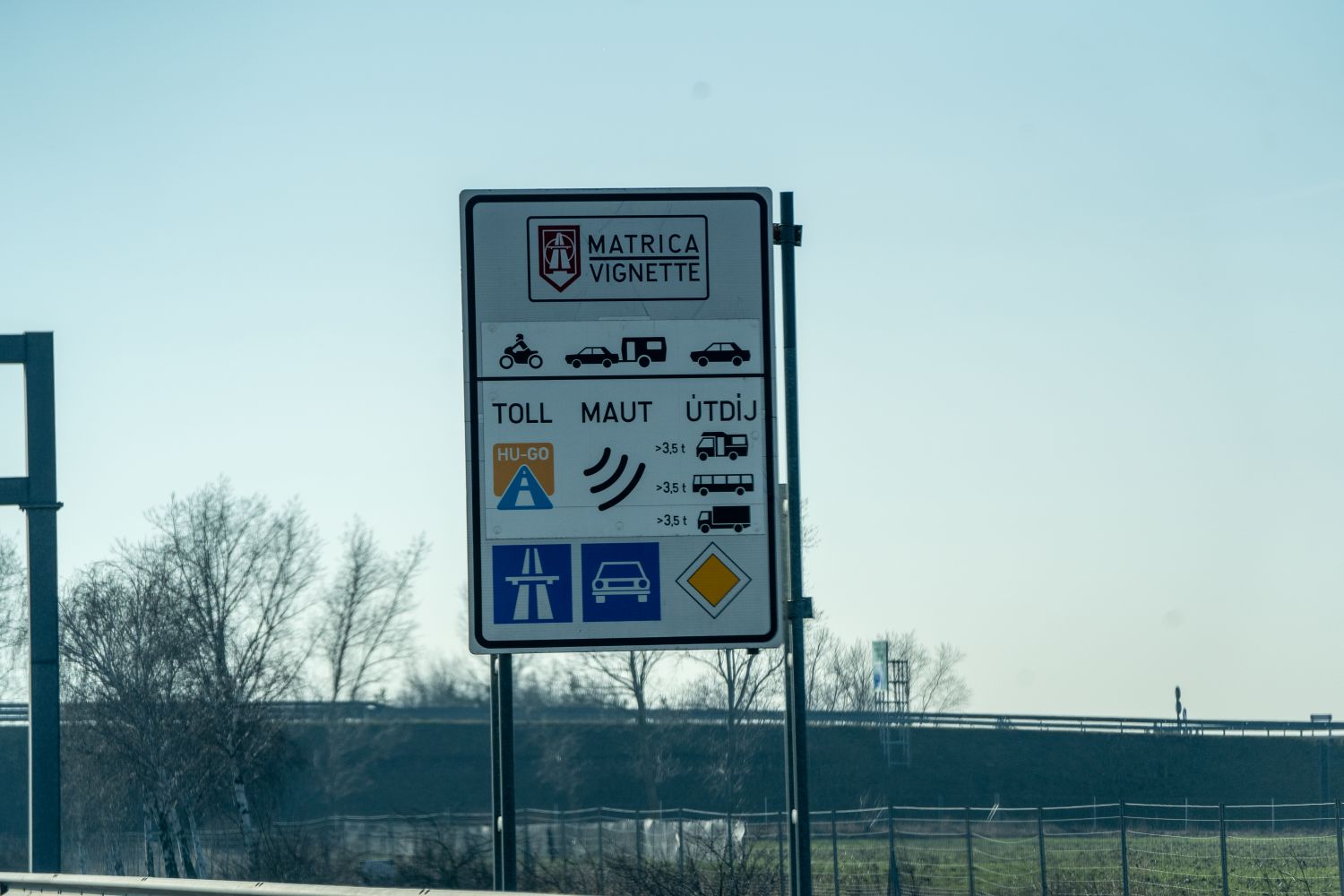
One scope note: this covers the e-Matrica system for vehicles up to 3.5 tonnes. Heavier vehicles, trucks and buses, use Hungary's separate distance-based HU-GO toll system for heavy vehicles above 3.5 T, with its own rules. The following are genuinely exempt:
- Ambulances, fire brigades, and other emergency-response vehicles on active duty
- Vehicles used by the police and other law-enforcement bodies
- The Parliamentary Guard (Országgyűlési Őrség)
- Hungarian Defence Forces vehicles, plus NATO and allied military vehicles stationed in or passing through the country
- Toll-road operator and road-maintenance vehicles, including (as of 2026) neighbouring countries' road-maintenance vehicles on shared cross-border stretches
- Vehicles of the transport authority carrying out road-use inspections
- Vehicles engaged in disaster prevention or response, including volunteer fire brigades and civil-defence units
- Diplomatic vehicles, on a reciprocal basis, and vehicles transporting humanitarian aid
- Vintage and historic vehicles officially classified under Hungary's motor vehicle tax law
Electric cars, motorcycles, and disability permits aren't on that list. Those are the three people ask about most, so each gets its own section below. Rules like these are set at national level and reviewed periodically, so it's worth a quick check before you travel if anything about your situation is unusual. For the full picture on which vehicles need an e-Matrica in the first place, see our guide to vehicle requirements and categories.
| Vehicle / driver category | Exempt? | Notes |
|---|---|---|
| Passenger car (D1) | No | Standard e-Matrica required |
| Motorcycle (D1M) | No | Own D1M category for short-term passes; annual bought as D1 |
| Van / motorhome (D2) | No | Standard e-Matrica required; all motorhomes covered since January 2026, regardless of weight |
| Trailer towed by D1 car | No | Covered under the car's D1 vignette |
| Trailer towed by D2 vehicle | No | Needs its own U-category vignette |
| Electric / hybrid / CNG car | No | No exemption or discount of any kind |
| Disability-permit holder | Partial discount only | Pays D1 rate instead of D2 rate, if pre-registered |
| Emergency / police / military | Yes | On official duty |
| Parliamentary Guard / transport authority inspection vehicles | Yes | Per official classification |
| Disaster-response / volunteer fire & civil defence | Yes | Per official classification |
| Historic / vintage-classified vehicle | Yes | Per official vehicle classification |
Categories are set by national rule and can change. Verify before you travel if your situation is unusual.
One distinction worth making: this is about who is exempt as a vehicle or driver, not which roads are toll-free. Some individual road sections carry no toll at all regardless of your vehicle, and a cheaper county vignette can cover you if you only drive within one or two regions.
Common Misconceptions: Motorcycles and Electric Cars
Two vehicle types cause more roadside surprises than any other: motorcycles and electric cars. Motorcycles need their own vignette category, and electric vehicles get no exemption or discount whatsoever, regardless of how green the engine is. Here's exactly what applies to each, so you can budget correctly before you cross the border.
Do Motorcycles Need a Vignette in Hungary?
Yes. Hungary's exemptions are defined by what a vehicle is officially used for, not by what type of vehicle it is, so an ordinary motorcycle never qualifies.
What you need: a valid e-Matrica for any tolled M-prefix motorway, expressway or main road.
Your category: D1M for the 1-day, 10-day and monthly passes, at roughly half the D1 rate. The annual vignette is sold as D1, at the full D1 price.
Can you register an exemption? No. There is no exemption route for motorcycles unless the machine independently qualifies under an official category, such as a police bike.
Are Electric Cars Exempt From the Hungary Vignette?
No. Hungary's exemptions turn on a vehicle's official role, not its emissions, so fuel type is not a criterion at all. Some countries do treat EVs differently: in Czechia, fully electric and hydrogen cars are exempt outright and plug-in hybrids under 50 g/km CO₂ pay a reduced eco rate. Hungary has no equivalent.
What you need: an e-Matrica, on the same tolled M-prefix motorways, expressways and main roads as any other car.
Your category: set by weight and seat count exactly as for the petrol version. D1 for a standard car, D2 for larger vehicles or those carrying more than seven.
Can you register an exemption? No. There is no EV exemption to register. Green plates bring benefits elsewhere, such as free parking in some cities, but nothing on tolls.
Disabled Drivers and the Hungary Vignette
Hungary does not exempt disabled drivers from the vignette. What exists is a partial exemption: if your car falls into the D2 category, you can buy the cheaper D1 vignette instead.
| Who qualifies | Holders of a Hungarian disability parking permit (parkolási igazolvány), or a close relative living in the same household. Also anyone receiving family allowance for three or more children. |
|---|---|
| What you get | A D1 vignette for a D2 vehicle |
| Before you travel | Register the plate at any government window (kormányablak or járási hivatal) |
| Limit | One vehicle per keeper at a time |
| Renewal | Permit holders: none. Valid until the permit is withdrawn. Family allowance: reapply annually, expires 31 January |
| If you already drive a D1 car | No benefit. You are already on the lowest rate |
Foreign permits do not qualify. The partial exemption runs on Hungarian records: it needs a Hungarian-issued permit and a vehicle on Hungary's register. Your EU parking card is still recognised here for parking, but parking and tolls are separate systems.
How to Register an Exemption
Qualifying does not clear you at the roadside. The exemption only takes effect once your licence plate is entered in the national exemption register.
- Check that your vehicle or role genuinely fits one of the categories above before you start the paperwork.
- Pull together your documents: your personal details, the vehicle's licence plate, and whatever proves the legal basis, such as a permit or an official registration.
- Head to any government window (kormányablak) in Hungary to submit the request. A few categories work differently: foreign military vehicles, road and toll operators, and certain crisis-transport vehicles go through a specific government department instead.
- Hold on to your registration confirmation. Coverage typically lasts from the day you register through to 31 January of the following year, though the exact terms shift slightly by category.
An unregistered vehicle is still fined. Toll control reads your plate at fixed control gantries and from mobile control vehicles, then checks it against the register. It has no way of knowing you would have qualified.
Our own team has seen this in practice: on a research trip along the M1 from Vienna toward Budapest in April 2026, our CEO Mattijs Wijnmalen observed enforcement cameras already active within 200 metres of the Hegyeshalom border crossing, with no purchase point on the Hungarian side. There's no buffer zone at the border for sorting out registration after the fact, so any exemption or discount needs to be filed before you reach Hungary, not once you're already on the motorway.
Don't fit any of the categories above? You'll need a valid e-Matrica before driving on Hungary's toll roads. Buy your Hungary e-Matrica online in minutes. As an independent reseller, every purchase is registered directly to the official NÚSz system at nemzetiutdij.hu on your behalf, and you can check your vignette's validity against that same official database anytime after purchase. We're not a government body ourselves, and exemption paperwork isn't something we can process. For that, use the official channel described above.
Buy your e-Matrica onlineFAQ
Written by: Freek Jurg, COO and Co-founder, Maut & Vignette B.V., 10+ years in tolling.
Reviewed by: Mattijs Wijnmalen, CEO and Co-founder, Maut & Vignette B.V., 10 years in European road tolling. Mattijs drove the M1, M5 and M7 corridors, including the Hegyeshalom border crossing, in April 2026 to research this guide.
Photography: Mattijs Wijnmalen, March 2026.
Last verified: 16 October 2026.
Sources: Magyar Közút Nonprofit Zrt. Toll Division (nemzetiutdij.hu); Government exemption register (kormany.hu); Decree No. 45/2020 (XI. 28.) ITM. This guide is for information only and is not legal advice. Exemption rules and prices can change, so check nemzetiutdij.hu before you travel. Evignettehungary.com is a private reseller of Hungarian e-vignettes and is not the Hungarian toll authority.

Freek Jurg is the COO and co-founder of Evignettehungary.com's operator, Maut & Vignette B.V. He co-founded the business with Mattijs Wijnmalen in 2014 and looks after day-to-day operations, including order processing and the IT integrations that register each vignette against the right vehicle.